Sony a7iii vs a7riii [The Ultimate Comparison]

This Sony a7 III vs Sony a7R III comparison is just what you’ve been looking for if you’re having trouble deciding between these two cameras.
Known as one of Sony’s flagship mirrorless cameras, the a7 III boasts a remarkable feature set that includes lightning-fast focusing, excellent full-frame resolution, 4K/30p video, dual card slots, and more.
In contrast to this, while the Sony a7 III is the newer and quicker mirrorless camera, the Sony a7R III will impress many photographers with its high-resolution megapixel count – particularly those who want to shoot commercially, landscape-style, or for other high-resolution projects.
So, one of these options is the best?
Continue reading to find out!
Key Specifications for the Sony A7 III
Sony a7 III Full-Frame Mirrorless Interchangeable Lens 4K HDR Camera ILCE-7M3 Body Bundle with Deco Gear Travel Bag, 2X 64GB Memory Cards, Editing Suite
- The announcement was made on February 27th, 2018.
- 24 Megapixels – Full frame Sensor with BSI-CMOS technology
- ISO 100 – 51200 ISO 100 – 51200 ( expands to 50 – 204800)
- Sony E Mount (Sony E Mount)
- Image Stabilization Using a Sensor Shift
- 3 Tilting Screens are available.
- 2360 kilobytes of data Viewfinder with an electronic display
- Continuous shooting at a rate of 10.0 frames per second
- 4K (UHD) video resolution (3840 x 2160 pixels)
- High-Definition Video at 120 frames per second
- Wireless built-in is a great feature
- 650g. Dimensions: 127 x 96 x 74 mm
- Body Protected from the Weather
- Sony Alpha A7 II has been replaced.
Key Specifications for the Sony A7R III
Sony a7 III Full Frame Mirrorless Camera with 28-70mm, FE 50mm f/1.8 Lens, 64GB Card, and Accessory Bundle (9 Items)
- The announcement was made on October 25th, 2017.
- 42 Megapixels – Full frame Anti-aliasing (AA) filter is not present in the BSI-CMOS sensor.
- ISO 100 – 32000 is a standard that specifies how many units of measurement are in a single unit of time ( expands to 50 – 102400)
- Sensor-shifting on the Sony E Mount Image Stabilization (also known as image stabilization) is a technique that helps to maintain the integrity of an image while it is being captured.
- 3 Tilting Screen 3686 kilobytes of data Viewfinder with an electronic display
- Continuous shooting at a rate of 10.0 frames per second
- 4K (UHD) video resolution (3840 x 2160 pixels)
- Wireless 657g is pre-installed. The weather-sealed body measuring 127 96 74 mm has been replaced. Sony Alpha A7R II DSLR camera
Sony a7iii vs. a7riii | What’s the Difference?
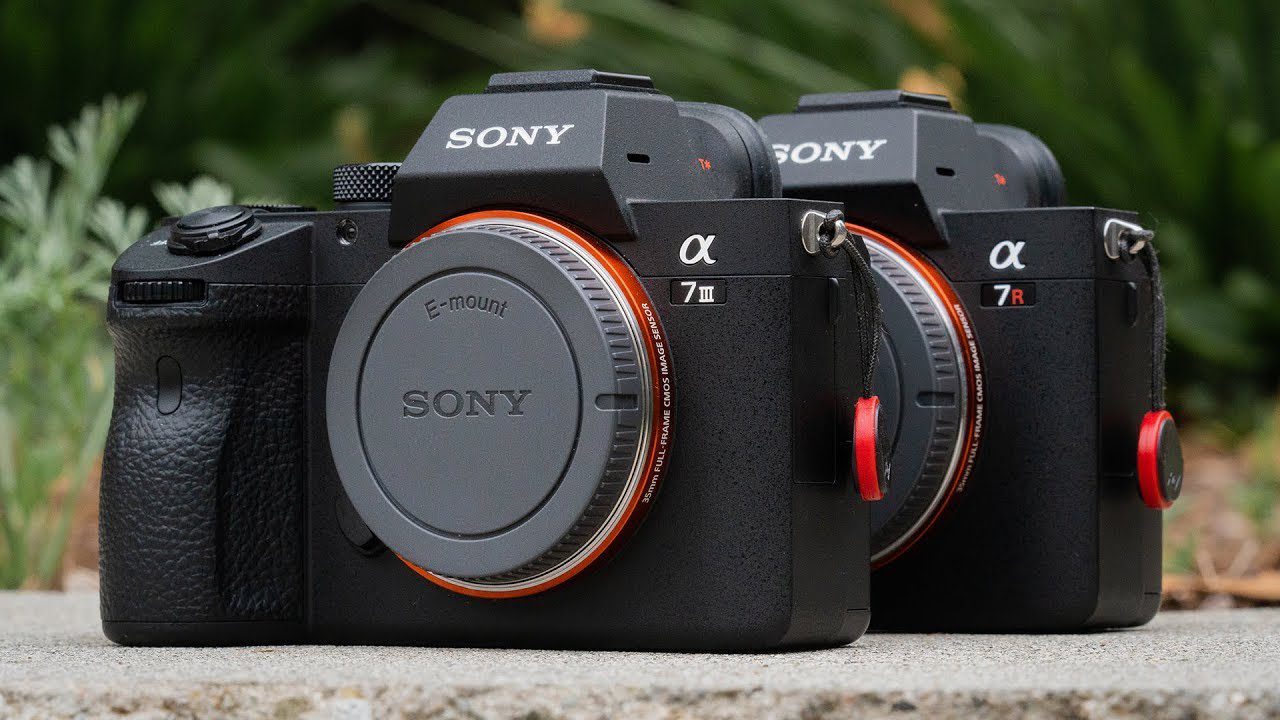
Due to the fact that the new A7 models are part of Sony’s professional mirrorless line’s third generation, its primary characteristics are already widely known.
But, to summarize, these are professional-level cameras equipped with full-frame image sensors that are substantially smaller and lighter than similarly equipped DSLRs from Canon or Nikon, respectively.
1. Dimensions and weight
When comparing the Sony a7 III and the Sony a7R III, you’ll be hard-pressed to find any significant distinctions between them.
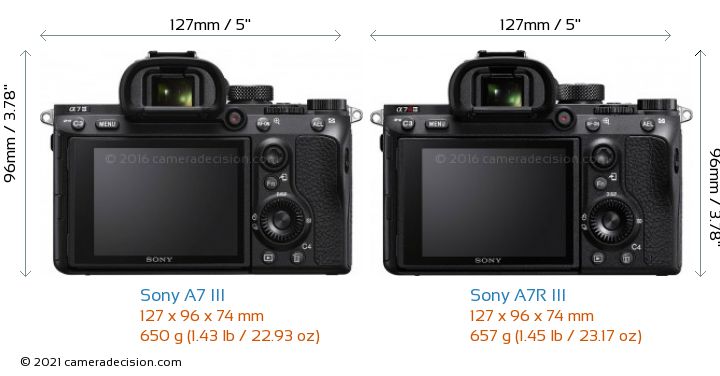
In truth, the bodies of the two cameras are nearly identical, with weights that are nearly identical: 650 g (23 oz) for the Sony a7 III and 657 g (23.2 oz) for the Sony a7R III.
They also have proportions that are virtually indistinguishable from one another:
The dimensions of the a7 III are 126.9 x 95.6 x 73.7 mm.
The dimensions of the a7R III are 127 96 74 mm.
These two cameras are very small and lightweight when compared to full-frame DSLRs, but they aren’t particularly small when compared to their mirrorless counterparts.
Having said that, the form-factor is rather appealing.
If you’re frequently hiking or traveling, either camera will help you to reduce the weight of your equipment by several hundred grams, and you won’t feel as uncomfortable carrying your camera around on the street or on informal outings with you.
The Sony Alpha cameras all have very identical bodies (you’ll see the similarities between the a7R II and the a7R III as well).
2. Image sensor and Processor
Despite the fact that both cameras use the same back-illuminated Exmor R CMOS sensor, the difference here is that the sensor in the a7 III has a resolution of 24.2 megapixels, whilst the sensor in the a7R III has a resolution of 42.4 megapixels, which is a significant difference.
Using the latest BIONZ X image processing engine and front-end LSI, both sensors are capable of faster readout speeds and data processing capabilities, which is beneficial for both applications.
There are several differences between Sony’s a7 III and a7R III sensors, one of which is that the a7R III does not feature an optical low-pass filter (anti-aliasing filter) in front of the sensor, whereas the a7 III does include an anti-aliasing filter.
In case you didn’t know, an anti-aliasing filter is a tool that helps to reduce distortion while simultaneously making images appear slightly less crisp.
As opposed to this, the a7R III is constructed so that it does not require an anti-aliasing filter, allowing for crisper images to be captured at higher resolution.
Both cameras have in-body image stabilization that works across five axes, but the A7r III’s is rated at 5.5 stops, whereas the a7 III’s is rated at 5 stops, making the A7r III the superior camera.
3. Performance in terms of dynamic range and ISO sensitivity
The ISO sensitivity range of the two cameras is just a little different from one another. In terms of native ISO range, the a7 III offers a 100-51200 native range and an enhanced range of 50-204800.
The a7R III features a native ISO range of 100-32000 and an extended ISO range of 50-102400.
Both cameras are capable of recording 14-bit RAW in both uncompressed and compressed formats.
According to DPReview, the a7 III’s basic ISO dynamic range is almost equivalent to that of the a7R III’s (14.6 EV for the a7 III and 14.8 EV for the a7R III).
If you wish to exhibit more dynamic range than is shown by the default tone curve, you can employ (brighten) shadows in Raw files, and both cameras will provide you with equivalent capabilities.
4. The Camera’s Physical Structure
The a7 III was built on a body that was extremely close (but not identical) to the a7R III.
To that end, you will appreciate that the a7 III retains its familiar touch screen, AF joystick, dedicated AF-On button, dual SD Card slots (one of which is UHS-II), a Protect/Rate button, the movie record button being moved closer to the viewfinder, and a new and significantly larger NP-FZ100 battery.
They are not, however, totally interchangeable. The front, side, and back covers of the a7R III are made of magnesium alloy, whereas the magnesium alloy on the rear cover of the a7 III is absent from the latter.
On top of that, the a7 III does not have a lock button on the mode dial, which is present on the a7R III.
An extra port for studio flash units and other external lighting equipment is also included on the a7R III, however, this port is not included on the a7 III.
The a7 III weighs around 650g, or 1 lb 7.0 oz (with battery and SD Card), which is 7 grams lighter than the a7R III, which is a significant improvement.
Dust and moisture resistance is built into the bodies of both the a7 III and a7R III, so they should both be capable of withstanding a brief downpour, but they are not waterproof in any way.
In order to avoid accidentally dropping your camera in a puddle if you are likely to do such a stupid thing, you should avoid setting your camera down in any puddles.
5. Autofocus is a feature of some cameras.
The Sony a7R III has a fast and accurate autofocus system.
It features a hybrid autofocus system with 399 phase-detection points and 425 contrast-detection points, as well as Real-Time Eye AF, which tracks the eyes of your subject as they move across the frame.
Although the a7R III is positioned as a high-resolution model rather than a fast-and-furious sports camera such as the a9 II, tracking on the camera is fairly capable.
The a7R III is an excellent choice for sports photography, even though it isn’t quite as responsive or quick to respond as other models – the a9 and a9 II, for starters, but also the a7 III, which has outrageously strong tracking skills, especially considering its low price.
In fact, the autofocus performance of the a7 III is nothing short of spectacular.
Despite the fact that it does not feature the most advanced tracking algorithms available in some of Sony’s more recent camera models, the Real-Time Eye AF is still quite useful for portraits.
Additionally, the camera’s 693 phase-detection AF points, 425 contrast-detection AF points, and wide viewfinder coverage all add to the camera’s ability to track and focus on subjects quickly, especially in low light.
For those who prefer to shoot in more of a generalist capacity, the Sony a7 III is the camera to choose from.
It will perform admirably while photographing stationary subjects such as landscapes and still lifes, but it will also perform admirably when photographing topics in a fast-paced environment such as sports or street photography.
Is the Sony a7 III’s tracking and focusing performance comparable to that of Sony’s current flagship sports camera, the a9 II?
No.
However, it is extremely fast, and it is more than capable of competing with higher-priced cameras such as the a7R III.
5. Take the wheel (FPS)
Both the a7 III and a7R III are incapable of competing with the actual action cameras on the market when it comes to shooting at high continuous speeds.
However, even with continuous autofocus, the a7 III and a7R III are capable of shooting at 10 frames per second, which is quite outstanding.
It’s even more astounding when you consider that the a7R III has a sensor with more than 40 megapixels because 10 frames per second at 40 megapixels every shot is a significant amount of data to collect.
As a result, for a genre such as street photography or wedding photography, where greater burst modes are extremely beneficial but not needed, either of these models will suffice.
The buffer on the a7 III is where the camera begins to stand out from the competition. You get 40 RAW shots (or 163 JPEGs), which is a significant improvement over the 28 RAW photos (or 76 JPEGs) you get with the a7R III.
In some situations, having that extra buffer can make a significant difference.
6. Shutter, continuous shooting, and buffer are all included
In addition to the electronic/silent shutter found in the a7R III, the a7 III now has one as well. Both cameras have the ability to shoot at 10 frames per second with either the electronic or mechanical shutter, but if you wish to use live view, you are limited to 8 frames per second.
The buffer on the a7 Mark III can hold up to about 177 JPEG images, 89 compressed RAW photos, or 40 uncompressed RAW photographs in a single continuous burst, depending on the image format.
In comparison, when shooting continuously on the a7R Mark III, 76 JPEG images, 76 compressed RAW images, or 28 uncompressed RAW images are captured.
It’s hardly unexpected that the a7R III’s buffer can only hold a few more photographs than the a7 III; this is primarily owing to the larger 42.4-megapixel sensor, which results in file sizes that are nearly twice as large as those of the a7 III.
6. Technical Specifications for Video
Both the a7III and the a7RIII are capable of recording 4K footage at up to 30 frames per second and 100 megabits per second using XAVC S compression.
When it comes to video, though, there are a few significant variations between the two cameras to take into consideration.
In addition, the a7 III can record 4K video at 24 or 25 frames per second with 0% sensor cropping, which is accomplished by capturing 6K video and downsampling it to 4K.
When recording at 30 frames per second, the image is captured at about 5k, resulting in a modest cut of 1.2x.
With the a7R III, you can capture video in 4K and full-frame, but because of the greater resolution of the sensor, there is more noise evident at high ISOs. Shooting in APS-C/Super 35 mode will assist to improve the quality.
For output to high dynamic range televisions, both cameras support in-camera picture profiles, including S-Log2, S-Log3, and an HLG (Hybrid Log-Gamma) profile, which eliminates the need for color grading.
They also offer both slow motion and quick motion modes (S&Q).
This enables you to choose between 1fps and 120fps for slow-motion and fast-motion clips, respectively.
7. Display (Viewfinder / LCD Screen)
The Sony a7 III includes a 2.36 million dot OLED electronic viewfinder with a refresh rate of 60 frames per second (exactly like its predecessor, the a7 II), which produces an image with a resolution of 1024 x 768 pixels.
Because it sports a 3.69 million dot OLED viewfinder with a quicker refresh rate of 100/120 frames per second, the a7R III outperforms the competition.
Touch controls are included on the back LCD panels of both cameras, allowing you to pick and move your focus point as well as zoom in and out.
In addition, you can tilt the screen upwards and downwards. The a7R III, on the other hand, outperforms the a7III thanks to its better resolution LCD screen (1,440k vs 921k dots).
When using focus magnification or the clear image zoom (digital zoom) mode, the greater resolution of both the viewfinder and the LCD screen of the a7R Mark III is quite advantageous.
8. Pixel Shift Multi Shooting (also known as “Pixel Shift Multi Shooting”)
One feature that the a7R III has that the a7 III does not is the Pixel Shift Multi Shooting mode, which is available only on the a7R III.
As a result of this function, the resolution of your photographs is increased by four times.
The camera takes four images, each of which has one pixel on the sensor moved by one pixel.
Using Sony’s Imaging Edge Software Suite (the camera itself does not do this), you can then combine these photos to create an image that has four times the resolution of a standard raw image (4 x 42 megapixel).
Despite the fact that the files you end up with are still 42 megapixels in size, they include significantly more detail, which is especially obvious when you zoom in at 100%.
Increased color accuracy and sharpness are the primary benefits of Pixel Shift; however, this is only true if your subject is completely motionless and your camera is mounted on a very strong tripod, as even the slightest movement would render the photographs unusable.
Photographic genres such as product photography, architecture photography, and still macro photography will benefit greatly from Pixel Shift’s capabilities.
Photography of landscapes is not recommended because there are most likely to be moving components such as clouds, flowing water, or the wind blowing objects about, amongst others.
9. Battery life and charger compatibility
Both cameras now use the NP-FZ100 battery, which is significantly larger than the previous NP-FW50 battery.
The NP-FW50 battery had a capacity of 1020mAh, whereas the new NP-FZ100 battery had a capacity of 2280mAh, according to the manufacturer. This provides a capacity that is more than double that of the previous battery.
According to official Sony estimates, the a7 III can take 710 shots (with an LCD screen) compared to 650 shots with the a7R III. The fact that you can actually fire many more pictures on a single charge in real-world settings should not be overlooked.
I’ve taken well over 1000 shots with my Sony a7R III before I’ve had to swap out the battery for another.
Cold conditions will also significantly shorten the battery’s lifespan.
Both cameras can be charged via a USB cable, and the Sony a7R III comes with the Sony BC-QZ1 Battery Charger as well. Unfortunately, the Sony a7 III does not come with a charger, so you’ll have to rely on USB charging to get your camera up and running.
Using the BC-QZ1 Charger, it takes around 5 hours to charge the NP-FZ100 battery, compared to 2.5 hours when using the USB charging cable.
10. Flash Sync Port
Despite the fact that both cameras have identical ports, the a7R III adds an additional flash sync port for use with studio flash units and other external lighting equipment.
Mode for APS-C and Super 35 cameras
Both cameras are capable of shooting in APS-C / Super 35 format.
Using this method, you can shoot with full frame lenses and a crop factor of 1.5x, or attach an APS-C lens to the camera.
Using an APS-C lens without selecting APS-C mode will result in black bars on either side of your image.
This is because an APS-C lens will not entirely cover the full-frame 35mm sensor when used in full-frame 35mm mode.
In spite of the fact that the Sony a7 III and the Canon EOS R both have this capability, when you use it, your maximum image size will be 10 megapixels (3936 x 2624).
However, due to the larger 42-megapixel sensor in the a7R III, when you use this camera in APS-C mode, the maximum image size will be 18 megapixels (5168 x 3448) due to the larger 42-megapixel sensor.
Personally, unless I was using an APS-C lens, I would prefer to crop in post-processing rather than utilizing APS-C mode on either of the cameras mentioned above.
Our Final Thoughts
Despite the 12 significant distinctions detailed here, the most significant distinction between these two excellent cameras is unquestionably the resolution of their sensors.
Although the Sony a7 III does not have the 42-megapixel resolution of the Sony a7R III, not every photographer desires or requires 42.4-megapixels, which is what the a7R III offers. Even for landscape photography, 24.2 megapixels is more than sufficient for the majority of individuals.
For those searching for a wonderful all-around camera that does not require 42.4 megapixels, the Sony a7 III is a great choice, and I highly suggest it.
In addition, if you photograph a lot of sports and activities, the a7R III’s faster focusing system, larger buffer, and a greater number of phase-detection points will serve you considerably better than the a7R III’s higher resolution.
You may already be aware, however, that the Sony a7R III will be the finest camera for you if you enjoy pixel peeping and need the sharpest images possible for your landscape photography, architectural photography, or portrait photography.
Have you already made up your mind?
Afterwards, it would be fantastic to learn which camera you ultimately chose on and why in the comments section below.
You might also be interested in my Sony a7 III Accessories Guide if you have settled on the a7 III as your camera. Due to the fact that they have a similar body design, they can also be utilized with the a7R III.
Frequently Ask Questions
Is the A7III a better option than the A7RIII?
The a7R III, on the other hand, outperforms the a7III thanks to its better resolution LCD screen (1,440k vs 921k dots).u003cbru003eu003cbru003eWhen using focus magnification or the clear image zoom (digital zoom) mode, the greater resolution of both the viewfinder and the LCD screen of the a7R Mark III is quite advantageous.
What exactly is the difference between the Sony A7RIII and the Sony A7III?
Firstly, the A7III and A7RIII have different megapixel (MP) counts on their respective cameras’ cameras’ sensors.u003cbru003eu003cbru003eWhen it comes to resolution, the A7III features 24MP, and the A7RIII has 42MP.u003cbru003eu003cbru003eIf you are photographing architectural or archive subjects, the sensor will shift to capture four additional photos and collect more data within the sensor during this time.
Is there a better camera on the market than the Sony A7III?
The Nikon Z6 II is Nikon’s response to the Sony A7III, and it is a good alternative for Nikon shooters who are committed to the brand.u003cbru003eu003cbru003eFull-frame sensors with a resolution of 24 megapixels offer a superb dynamic range, and the phase-detect autofocus mechanism is one of the best I’ve encountered.u003cbru003eu003cbru003eIn addition, the Nikon Z6 II is the most comfortable camera to handle out of all the cameras on this list.u003cbru003e
Originally posted on December 24, 2021 @ 4:46 pm
![Sony Imaging Edge Webcam [How To Use It?]](https://reneerobynphotography.com/wp-content/uploads/2022/01/A7IIIWebcam.00_05_00_16.Still002-768x432.jpg)


![Best Led Light Kit for Video [2022] (10 Recommendations)](https://reneerobynphotography.com/wp-content/uploads/2022/01/0-Best-Lighting-Kits-3pt-1280x1031.5816005041-c-default-768x619.jpg)
![The Ultimate Comparison of Canon R VS R6 [2022]](https://reneerobynphotography.com/wp-content/uploads/2022/01/canon-r-768x432.jpg)